 Using Codea
Reference Projects, collections, sharing, storage, tools, and settings
Project Browser
The project browser top ↑
The project browser is Codea’s home screen: open a project to edit it, run one to try it, or organize your work into collections. A project contains its Lua code, settings, and any assets stored with it.
Find your way around
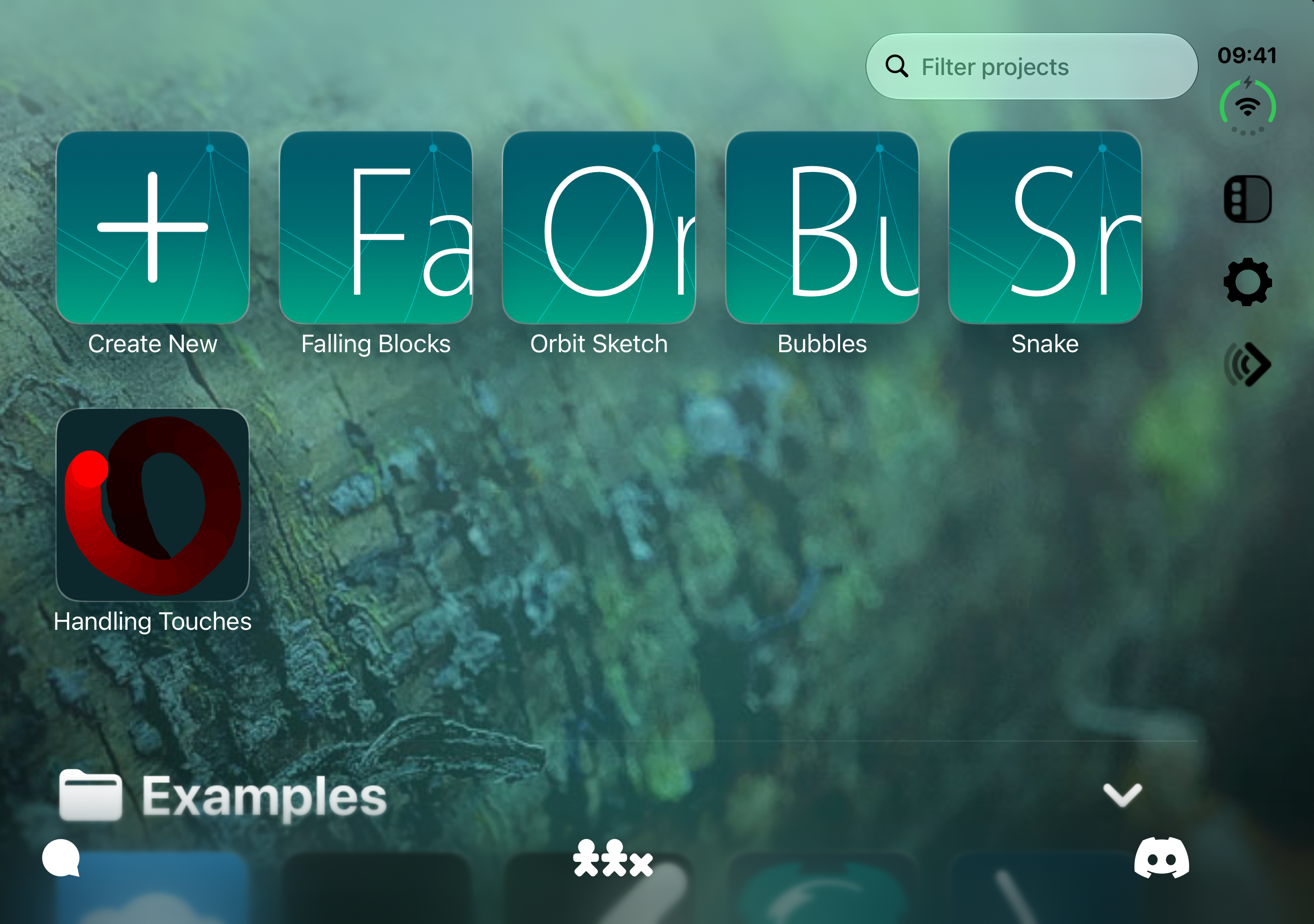
- Project grid: tap a project to open its editor. Touch and hold a project for actions such as Play, Duplicate, and Export. With a mouse or trackpad, use the secondary click.
- New project: use the add-project tile in the grid. The creation form lets you choose a name, template, destination, and tint.
- Left sidebar: open the tools/collections sidebar to browse Reference, Assets, Shader Lab, and your collections.
- Settings and Air Code: use the gear to open Settings and the Air Code control to open its connection menu. Air Code is also available within Settings.
Start with an example
Open an example to read its code, or choose Play from its menu to run it. To experiment without changing the supplied version, choose Duplicate, give the copy a useful name, and save it in your own collection. Built-in examples do not offer all of the same actions as your own projects.
Try duplicating a drawing example, changing a color, and running it again. See How Codea Works in the Lua chapter to learn about setup(), draw(), and responding to input.
Finding and organizing work
Use Filter projects to find a project by name. Keep related projects in collections and collapse the ones you are not using. Choose Recent or Name in Settings > Projects to sort the grid.
Features marked Pro require Codea Pro.
Creating and customizing projects top ↑
Start a new project or duplicate one to build on an existing idea.
Duplicate a project
Touch and hold a project and choose Duplicate. Choose a name and destination for the copy. Duplicate built-in examples before experimenting if you want to keep the originals.
Rename a project
Touch and hold a project and choose Rename. Enter a new name and confirm. To rename a built-in example, duplicate it into your own collection first.
Set a custom tint
The project form includes a Tint color picker next to the icon. Set it while creating or duplicating a project. For an existing project, open Rename, leave the name unchanged if you wish, and adjust its tint before confirming.
The tint changes the project icon. Use Clear Tint to restore its automatic color, and check the preview before saving.
Organizing project collections top ↑
A collection is a named group of projects. Use collections for lessons, game ideas, reusable libraries, or finished work. Each collection has a Local or iCloud location, shown beside its name in the sidebar.
Create a collection
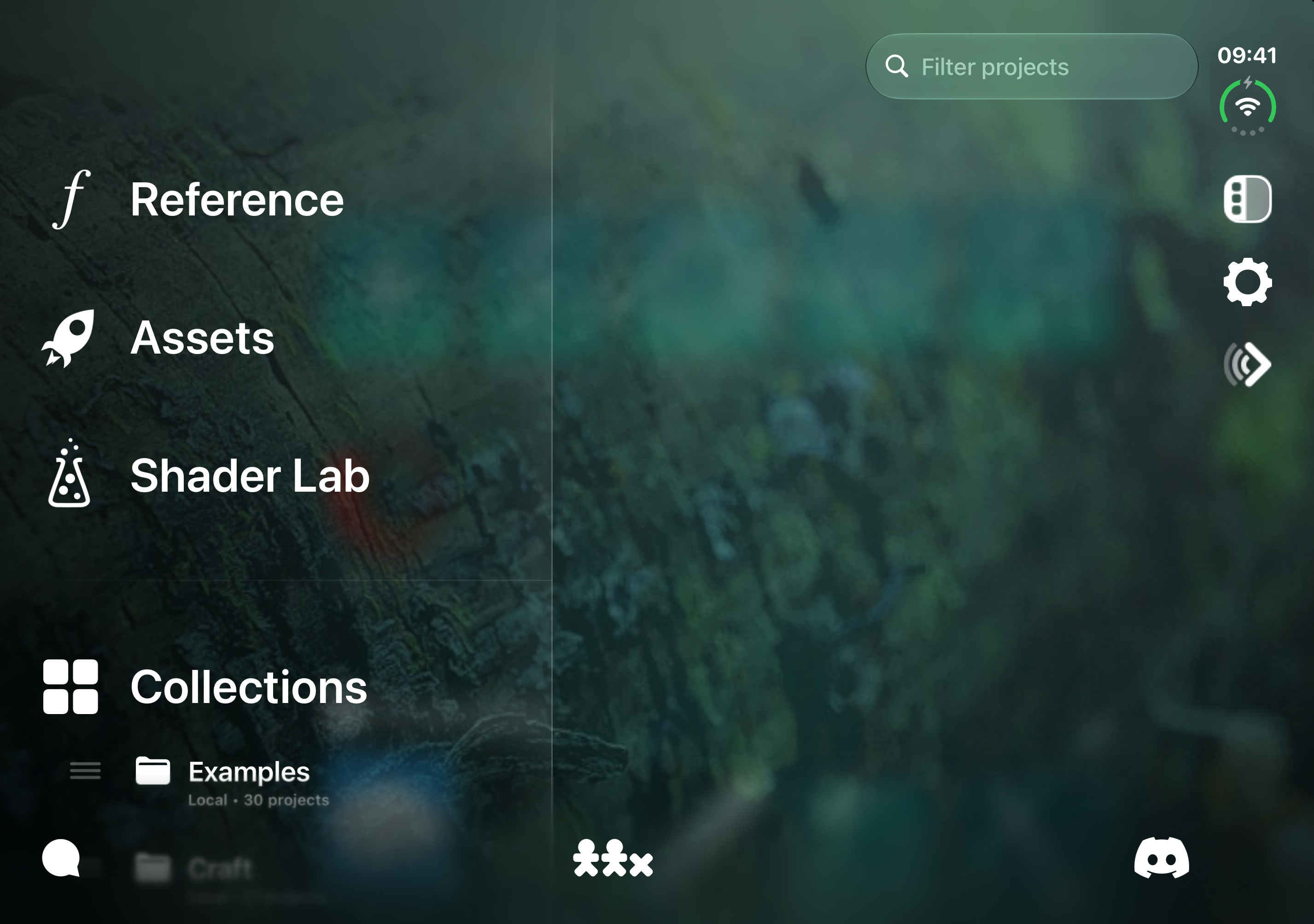
Choose a distinct name in that location. Creating custom collections is a Codea Pro feature.
Reorder collections
Drag the handle beside a collection in the left sidebar to change its position in the project browser.
Expand and collapse the grid
Tap a collection’s header in the grid to show or hide its projects.
Move projects between collections
Touch and hold a project, then drag it to another collection in the grid. If the destination has both Local and iCloud storage, Codea asks which location to use.
Projects within a collection follow the Recent or Name sorting choice in Settings > Projects. Dragging within the same collection is not a manual project-ordering feature.
Deleting a collection also deletes the projects it contains.
Sharing & Storage
Sharing and exporting projects top ↑
Choose a sharing method based on what the recipient needs: a playable project, editable source, or a standalone app project.
Share a playable link
Anyone with the link can play your uploaded project on an iOS device. Links expire 30 days after creation or an update.
After changing the project, return to this screen and choose Update Shared Project… to publish the latest version at the same link. Local edits do not automatically update the uploaded version.
Send editable source
Choose Send Project File… to share the project document through the system share sheet. Export > Zipped Project packages it as an archive. Export > Copy Code copies the code as text; use a project file or archive when the recipient also needs its assets.
Export an Xcode project
Xcode export requires Codea Pro. Build and test the exported app before submitting it to the App Store.
Export an Android project
Choose Export > Android Project where available. This option is marked Beta and requires Codea Pro. Complete the export settings, save the archive, then extract it on your computer and open the generated Gradle project in Android Studio.
Test the exported app on Android, especially any platform-specific features.
Local, iCloud, and collaboration top ↑
Keep projects on your device or use iCloud to work on them across devices.
Choose where to keep a project
Local projects live on this device. They remain usable without iCloud and do not automatically appear on your other devices.
iCloud projects live in Codea’s iCloud Drive storage. iCloud synchronizes them across devices signed in to the same Apple Account. A project may need to download before it can be opened; its menu can offer Download Now. Editing iCloud projects in Codea requires Codea Pro.
Check the collection’s location label or the project’s cloud indicator to see where it is stored.
Move between locations
Touch and hold a local project and choose Move to iCloud, then confirm. For an iCloud project, choose Move to Device and confirm. These are moves, not duplicate copies. Duplicate first if you want to keep independent versions in both locations.
Wait for syncing to finish before opening the project on another device. You can also move an iCloud project to your device to edit it without Codea Pro.
Collaborate through iCloud
Keep the project in iCloud Drive. In Files, find it under iCloud Drive > Codea, touch and hold it, and choose Share. Select Collaborate rather than sending a copy, choose who can access it and whether they can make changes, then send the invitation.
Collaborators work on the same project. Coordinate edits to the same Lua file and let iCloud finish syncing between devices. Use the sharing controls in Files to manage participants or stop sharing.
See Apple’s iCloud sharing guide for invitation and permission controls. Use a playable link when you want someone to play your project without editing it.
Accessing projects in Files top ↑
Use the Files app to find, back up, and share your Codea projects.
Find local projects
In Files, open Browse and choose On My iPad > Codea or On My iPhone > Codea. Collections appear as folders, and projects have the .codea extension, which Files may hide.
Find iCloud projects
Choose iCloud Drive > Codea. If it is missing, check that iCloud Drive is enabled and Codea has access to it. Projects may need to download before opening.
Work with project documents
Touch and hold a project for actions such as Copy, Move, Rename, Share, or Compress. Keep the whole .codea package together so its code and assets travel with it. Tap a project to open it in Codea; opening external projects can require Codea Pro.
You can also move projects using Move to Device and Move to iCloud in Codea. Changes made in Files affect the projects you see in Codea.
See Apple’s Files guide for the current location sidebar and file-management controls.
Tools & Settings
Air Code: work from your computer top ↑
Air Code lets you edit a project on your computer while it runs on your iPad or iPhone. Use Visual Studio Code for code completion, reference information, and debugging.
Open Air Code in Codea
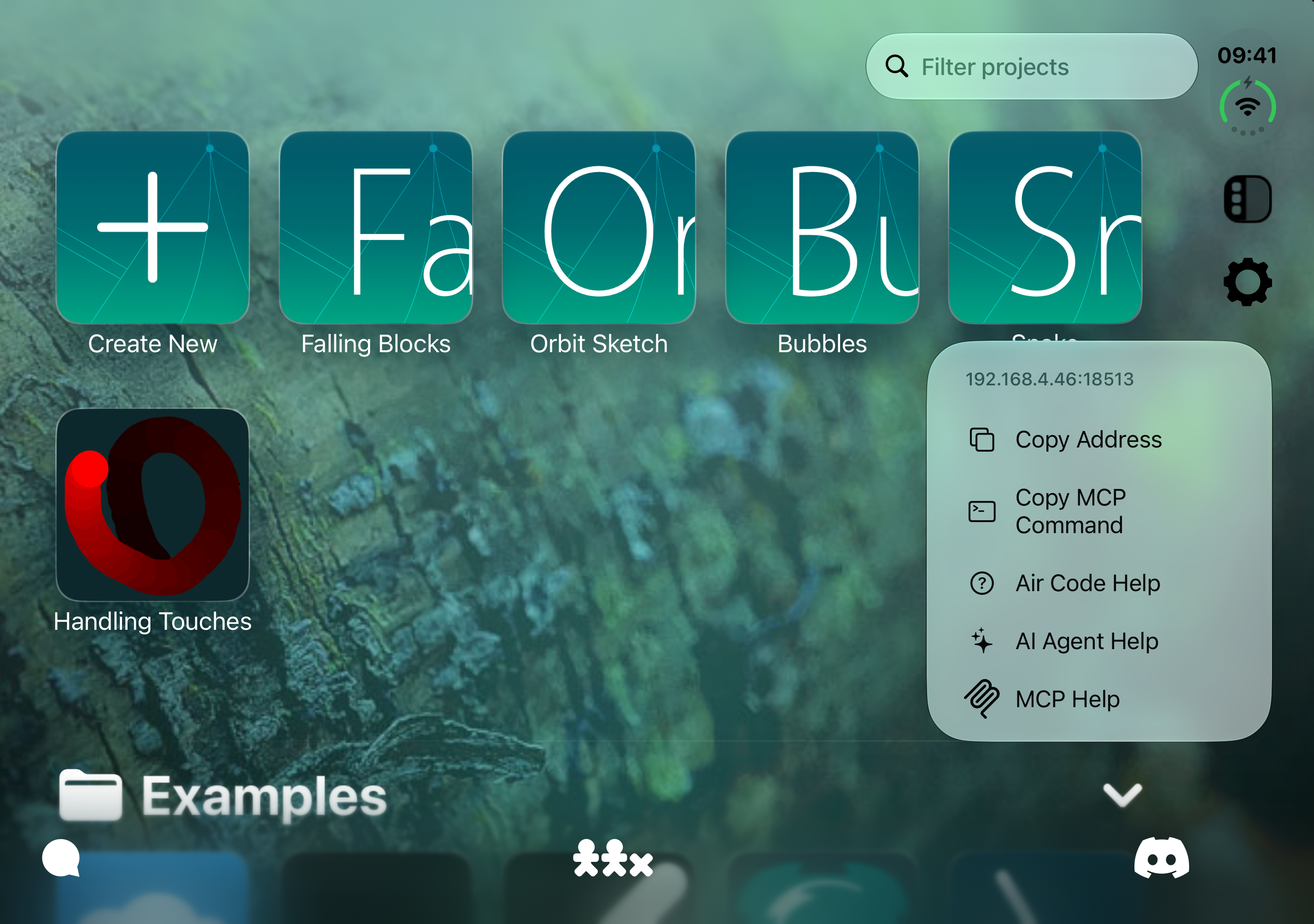
Open Settings > Air Code and turn on Enable Air Code. Use Copy Address to copy the server address, or Setup Guide for help. The main-screen Air Code menu also shows the address and help links. Air Code requires Codea Pro.
Connect Visual Studio Code
Use the Codea sidebar in VS Code to browse the reference and adjust project parameters. Attach the debugger to set breakpoints and inspect variables. Your edits update the project on the device.
If a device does not appear, check that Air Code is enabled and use the displayed address directly. The Setup Guide also covers USB connections when the network is unsuitable.
Command-line and agent tools
The Air Code settings also include Install Codea CLI, Install Agent Skill, and MCP Server setup. The install buttons copy commands to run on your computer. Use these tools to transfer projects, run them, read logs, and capture screenshots from your terminal or coding agent.
Further reading
- Air Code setup and usage — the VS Code extension’s official documentation.
- Codea CLI on GitHub — installation, connection, project-transfer, and automation workflows.
Reference, Assets, and Shader Lab top ↑
Open the left sidebar to find Reference, Assets, and Shader Lab.
Reference
Open Reference to browse by chapter or search for a function.
Guides explain how to get started; reference entries describe individual functions and properties. Use Run Example to try a project and Controls to adjust its parameters. Show code expands a long sample.
Assets
Open Assets to browse images, sounds, and models. Use the asset picker while writing code to insert an asset key. Keep assets in your project when you want them included as you share or export it.
Shader Lab
Open Shader Lab (Codea Pro) to edit shaders and preview the result. Compiler errors help you find mistakes in the code. See Shaders & Meshes for materials, shader builders, and compute examples, and test your shader in the project where you plan to use it.
Useful settings and backups top ↑
Open Settings from the project browser to adjust the editor, organize projects, and make backups.
Editor
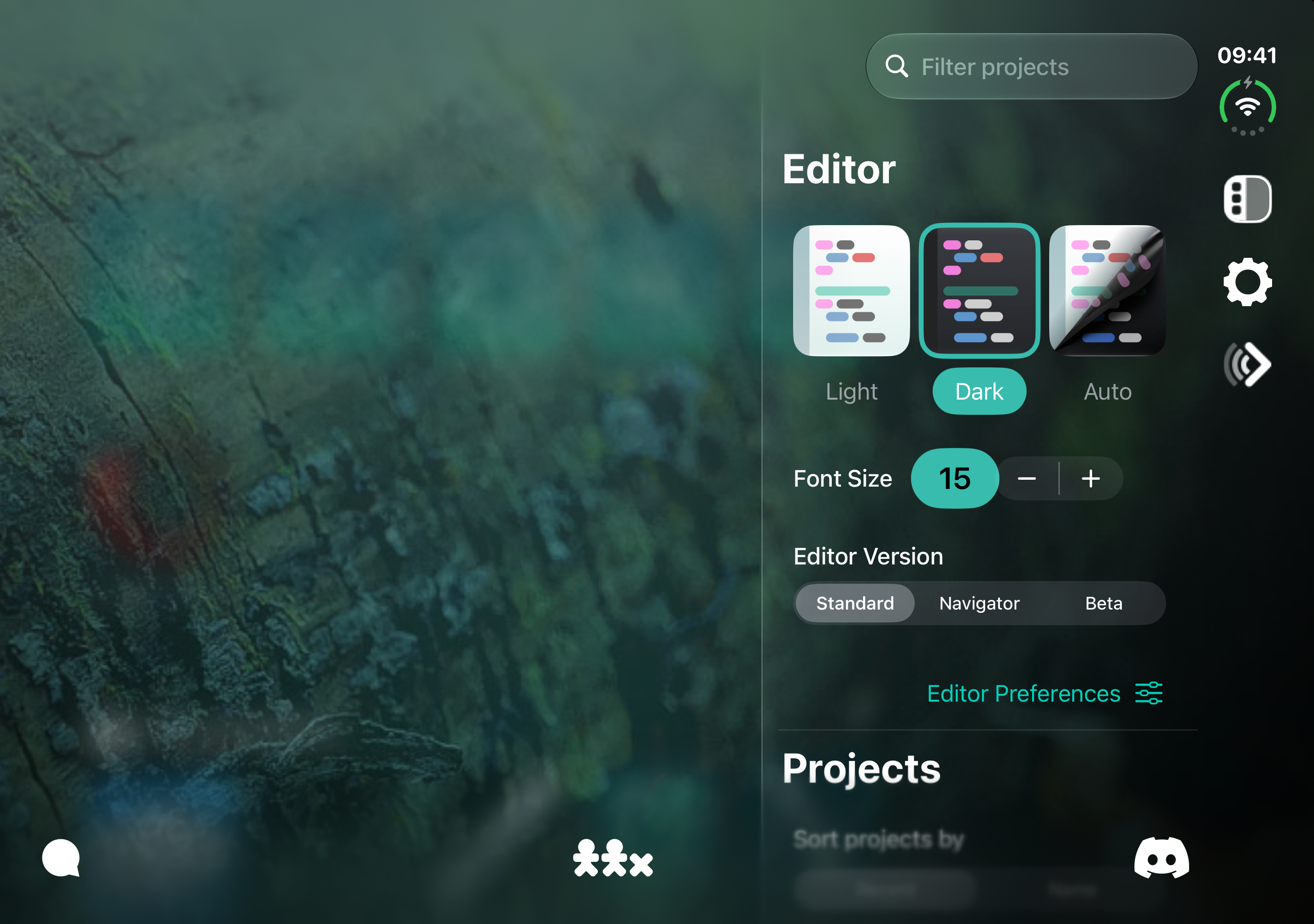
Choose an editor appearance and font size. Open Editor Preferences for line wrapping, formatting on paste, scrolling, autocomplete, and Code Notes. Use Editor Version, where available, to choose the editing interface.
Projects
Sort projects by Recent or Name, and choose Small or Large project icons.
Restore All Examples replaces the built-in examples with their original versions. Duplicate any edited examples into your own collection first to keep your changes.
Export All Projects creates CodeaProjects.zip for you to save or share. It includes local projects, excluding built-in examples and some support files. Back up iCloud projects separately through Files or by exporting them.
Air Code
Enable the remote connection, copy the server address, or open the setup guides for VS Code, the CLI, and MCP clients. See the Air Code page in this chapter for the connection workflow.
Windowing
Choose Single Window to open and run projects in the current window, or New Window to use separate windows on supported devices.
Subscription controls
Use Manage Subscription to manage Codea Pro.